

Why we need crypto: what card processors say about sites like ours, and what paying here actually involves
Every membership on Allison Feet is paid in cryptocurrency, or arranged by email. Not because we love crypto: standard card processors refuse sites like ours, and the few billers that do not would put their fees into your price. The full reasoning, the safeguards, and the way around it.
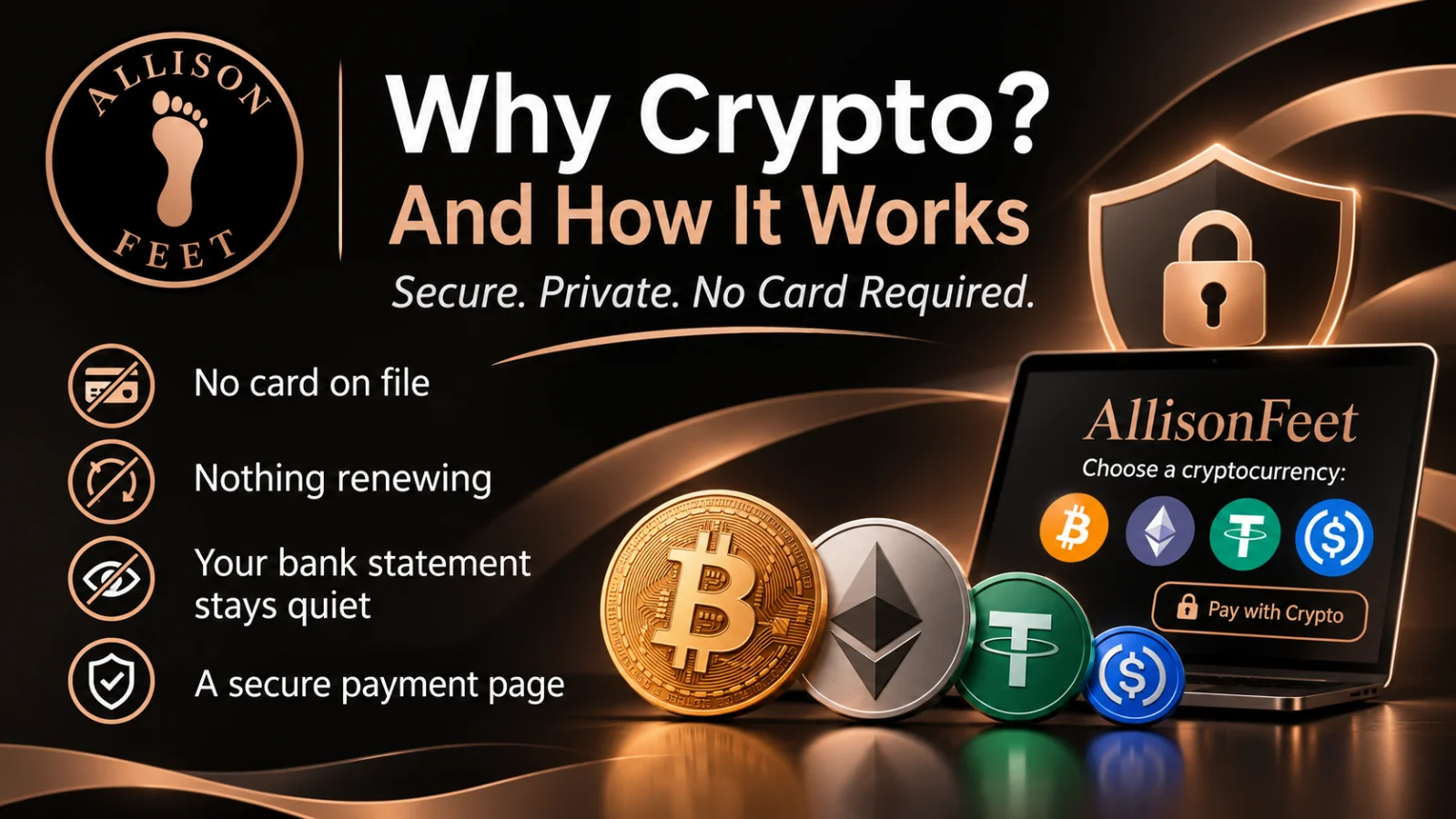
Every membership on Allison Feet is paid in cryptocurrency on a secure payment page, or arranged by email with a person. There is no card button, no phone wallet and no bank-transfer form, and new members ask about that more than about anything else. We did not choose crypto for its own sake. The payment industry chose it for us.
This post sets out the reasoning: what the card processors say about sites like ours, what the specialist billers that do accept them would cost you and the sellers here, why a prepaid membership and a crypto payment suit each other, what paying here involves, and the parts that are still a nuisance.
The short version
- Standard card processors refuse us. Their published lists name fetish content outright, however legal and well run the site is.
- The specialist adult billers would make you pay for their fees. Percentages far above a normal shop, very high fixed yearly registration fees with the card networks, months of held-back money, and a rule that every upload is reviewed before it goes live.
- Crypto fits a prepaid membership. Nothing is stored that could charge you again, nothing renews, and nothing with our name on it appears on your bank statement.
- You do not have to hold any crypto today. A dollar-stable coin bought at an exchange does it in about ten minutes, and the email route is always open.
- Sellers are not affected. Buyers and sellers pay each other however they agree, and we never touch that money.
What the card processors say
The companies that put a card form on an ordinary website publish lists of what they will not process, and adult content is on every one of them. Several name "fetish" content in so many words; a few refuse any platform where creators sell content to fans, whatever the content is. The big phone wallets apply the same rules. An application from a feet platform is declined at the category, before anyone reads what the site does, how every member is identity-checked, or what the content rules are.
This is not a loophole we failed to find. Adult content is a legal, registered category with the card networks, with its own merchant code, risk programmes and fees, and ordinary processors do not take part in it. The sites that do take cards for this kind of content go through a handful of specialist billers.
What the specialist billers would cost
Those billers exist, they are licensed, and plenty of sites use them. What they charge, and what they require, is the reason there is no card button here:
| A specialist card biller | Crypto, as it works today | |
|---|---|---|
| Share of every payment | About five to fifteen per cent, before the card networks' extra fees on the category | A small processing fee, which we pay |
| Fixed costs | Yearly registration with the card networks, four figures a year in total, whether a site sells ten memberships or ten thousand | None |
| Money held back | A rolling reserve of five to ten per cent, held for about six months against chargebacks | Nothing |
| What you would notice | The biller's name next to ours on your card statement, and all of the above in the price | A transfer from your wallet or exchange, at the price on the plans page |
| What sellers would notice | Every photo and video reviewed before it is published, as the card networks require of adult merchants | Uploads appear as they do now |
A membership paid by card would therefore cost noticeably more than it does, or we would have to do what most platforms do and take a percentage of every sale between buyers and sellers to cover it. We would rather sell a plain yearly membership, take nothing from sellers, and ask you for one unfamiliar step at checkout.
Why crypto and a prepaid membership suit each other
Memberships here are paid once, for a year, and simply end. That model came first, and the two fit well:
- Nothing is stored that could charge you again. A card on file is what makes "forgot to cancel" possible. A crypto payment is a one-off transfer: no card, no mandate, no token to forget about.
- Nothing renews. The plans page and an email three days before the end tell you when a year runs out. Buying the next year is a decision you take, not one taken for you.
- Your bank statement stays quiet. Buying a dollar-stable coin at an exchange shows up as exactly that. Nothing with our name on it reaches your bank.
- The contract record is yours. Every payment produces a confirmation email stating what you bought, until when, and the price. The 14-day right of withdrawal applies as to any purchase, through the withdrawal form.
What paying here involves
- Open the plans page and pick a tier.
- Press pay. You go to a secure payment page run by our payment processor, where you choose a coin and a network.
- Send the exact amount shown, on the network shown, from your wallet or straight from your exchange account.
- Come back to the plans page. It updates by itself as the network confirms the transfer, usually within a few minutes.
- Access opens the moment the payment is complete, and the confirmation email arrives.
The cheapest route is a dollar-stable coin on a low-fee network: it holds its value to the dollar, so the price you see is the price you pay, and sending it costs cents. The payment page shows the minimum for each coin before you choose. Never used cryptocurrency before? How to pay with crypto in ten minutes walks you from your bank account to a paid membership, for Europe, the United States and the United Kingdom, with the fees of each route.
If a wallet sends slightly less than the amount asked, or the transfer arrives late, the membership is not switched on automatically. Nothing is lost: email us with the reference the plans page shows and we finish it together. And if you would rather not touch crypto at all, email info@allisonfeet.com and a person arranges the payment with you. That route is not going away.
What we never do with your money
- We never hold a balance for you. A payment is a purchase, not a deposit: nothing sits in an account in your name with us.
- We never see your wallet. We send the processor a payment reference, the plan description and the amount. The coin, the network and the address you pay from go to the processor when you pay on its page, not to us. The Privacy Policy and the Terms name the processor.
- We never pull a payment. There is no auto-deduct and no stored authorisation. Every payment starts with you pressing pay.
- Refunds come back the way you paid. A refund, after a declined identity check or a withdrawal within 14 days, is made in the same coin, to a wallet address you give us by email, for the dollar amount due.
"But you tell us to be wary of crypto in chats"
We do, and the two positions are consistent. The safety guidance here says that between members, a buyer should prefer a payment method that can be disputed over gift cards or crypto, and that a message asking for crypto in a private chat is one of the patterns flagged for a person to review. The reason is who is on the other end: a member you have known for a day, who can disappear with the money.
Paying for a membership is a different transaction. You pay the site itself, on a payment page with a receipt, with a confirmation email as your contract record, a 14-day withdrawal right behind it, and a person who answers email and can see the payment reference. The access you paid for switches on by itself, so there is nothing to chase. Crypto between strangers is a risk; crypto to someone you can hold to account is just a payment rail.
Here is the honest part
- Crypto is an extra step for many people. Buying a coin at an exchange, with the identity check an exchange requires, takes most people ten to twenty minutes the first time. The guide exists because of that, and the email route for anyone who would rather not.
- A wrong network loses the money. Coins sent on a network other than the one the payment page shows cannot be recovered by anyone, including the processor. The page names the network; read it twice.
- Your wallet's own network fee is extra. The price on the plans page is what we receive; what your wallet or exchange charges to send it is theirs, and on the right network it is cents.
- The exchange sees that you bought crypto. It does not see what you spent it on, but the purchase is on its record, as any purchase is on a bank's.
- A card button would be simpler, and we know it. If a biller ever offers to take this site at a rate that does not have to go into your price or come out of sellers' earnings, we will add it next to the crypto option. The memberships themselves would not change: prepaid, nothing renewing, the identity check included.
Where to go next
- Pick a tier on the plans page; the three are explained in Three memberships: Chat, Video and Live.
- Never used crypto? Read How to pay with crypto in ten minutes.
- Selling here? The sellers page explains what is free for life and what new sellers pay.
- Staying safe between members is on the safety page, including the rule about crypto in chats.
- Still unsure? The FAQ answers the rest.
No card on file, nothing renewing, nothing taken from your sales: crypto is the price of keeping it that way.