Someone stole your feet pics? How to make theft harder, and how to get copies taken down
No site can stop a screenshot, and ours cannot either. What you can do is make a stolen photo worth less, prove in minutes that it is yours, and get copies removed. What to do before you upload, how to find copies, and how a takedown notice works, here and elsewhere.
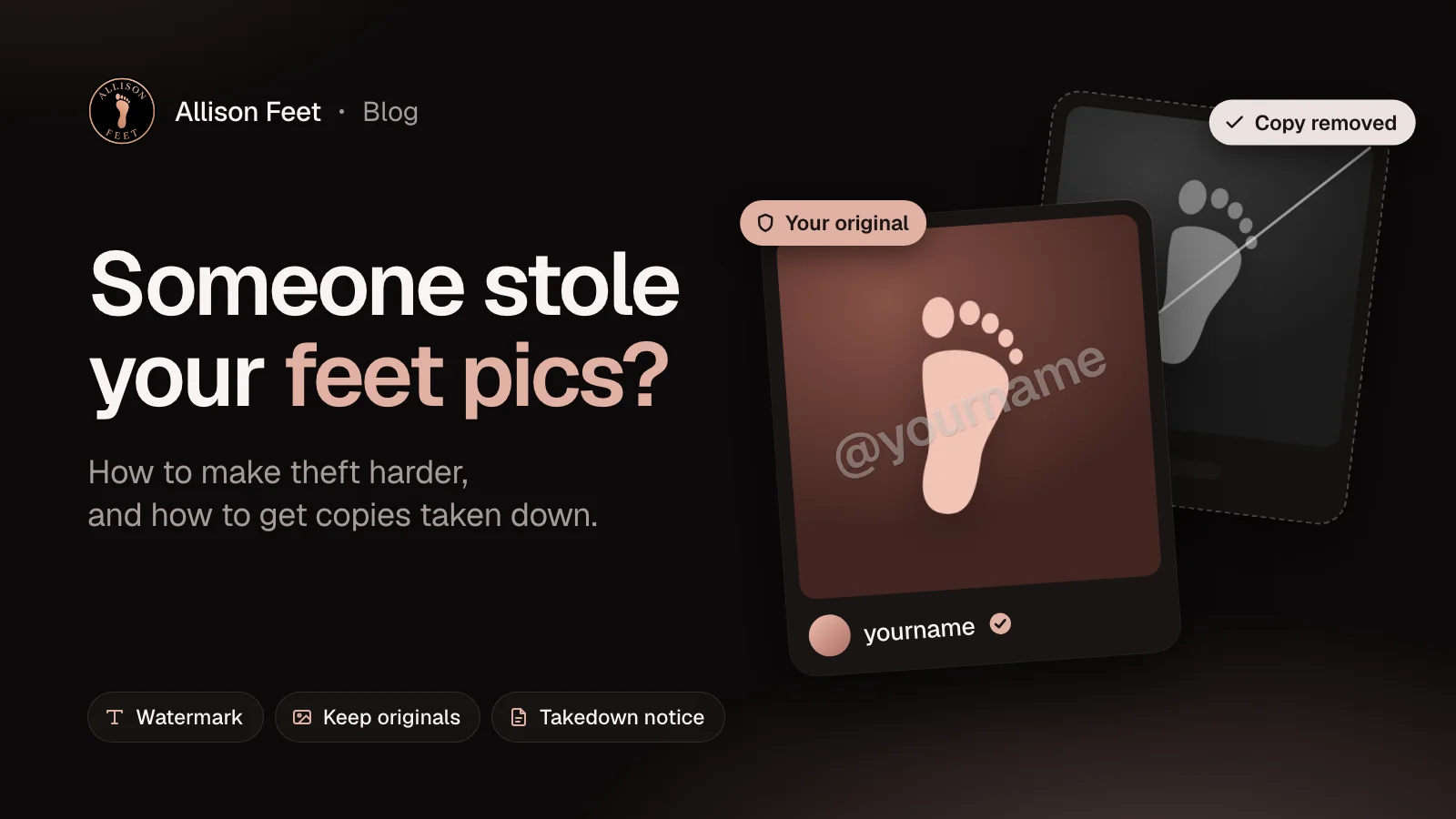
Sooner or later, most sellers find one of their photos somewhere they did not put it: on a stranger's profile, in a group, or on a site that collects other people's work. It feels personal, and it is also the most ordinary problem in this business. Anything that can be seen on a screen can be copied from it.
So this post does not promise that your photos cannot be taken. It covers the three things that are in your hands: making a stolen photo worth less to the person who took it, being able to prove in minutes that it is yours, and getting copies removed, on this site and on others.
The short version
- Nobody can stop a screenshot. Not us, and not any other site, whatever it claims.
- A watermark across the middle turns a stolen photo into an advert for your profile.
- Your unmarked originals are your proof. Keep every one of them.
- A takedown notice is a short letter, not a lawsuit. Most platforms act on one within days.
- A copy on this site goes through the report form, and the account that posted it belongs to a person who passed an identity check.
What the site does, and what it cannot do
It helps to know exactly where you stand before you upload anything.
| What happens here | |
|---|---|
| Who can see your gallery | In most countries, anyone, behind an 18+ notice. Where the law requires an age check first, only verified members |
| Hidden data in your photos | Removed. Every photo is rebuilt in your browser before it is sent, so the location, the date and the camera details stay on your phone |
| Size of the stored photo | At most 2,560 pixels on the long side |
| Watermark | None is added. Your gallery shows photos exactly as you upload them |
| Copying by members | Against the Terms: no scraping, no bulk downloading, no redistributing |
| Screenshots | Cannot be prevented, here or anywhere |
Treat your gallery as a shop window, then. It is there to be seen, and everything in it should be something you are content for the whole street to look at.
Five habits before you upload
1. Put your username across the middle. A plain font, about 30% opacity, at a slight angle, over the part of the photo that matters. A mark in the corner is cropped off in two seconds. A mark across the arch of the foot has to be painted out by hand, and most thieves move on to an easier photo. The seller toolkit explains how to add one.
2. Keep every original. The unmarked, full-size file from your phone is the strongest proof you will ever have. It carries the date and the device in its hidden data, it is larger than any copy taken from a site, and it sits next to the other frames from the same shoot. A thief has one photo. You have the whole session, including the ones that did not work.
3. Show your range, not your best work at full size. The gallery is the sample. What a buyer pays for should be something that is not already on public view.
4. Take the photo yourself. In almost every country, copyright belongs to the person who takes the picture, from the moment it is taken, with nothing to register. A tripod and a timer keep that person you. It is also the rule here: the Content Rules allow only content that you made and own.
5. Mark custom work for the buyer it was made for. A small mark that differs per buyer, such as their username in a corner as well as yours across the middle, tells you where a leak started. Under the Terms, what a buyer receives is for private viewing only. Reposting or reselling it is prohibited, and a buyer who does it here is a verified person, not a throwaway account.
One more thing belongs on this list: do not send unmarked samples to someone who keeps asking for one more. That is content theft with extra steps, and it is number four in our scam red flags.
How to find copies
Once a month, pick the three or four photos that do best for you and run them through a reverse image search. Google Lens, TinEye and Bing all do this free of charge: you give them a photo and they show you the pages where it, or something very close to it, appears. Search the marked version, and also a tight crop of the feet alone, because a thief will have cropped it too. Then search for your username in quotation marks.
This will not find everything. Private groups, chat apps and pages behind a login are invisible to a search engine. It does find the public copies, and those are the ones that cost you buyers.
When you find one, save the evidence before you do anything else: the link, and a screenshot that shows the page address and the date. Copies have a habit of vanishing and reappearing, and a notice needs an exact location.
Getting a copy taken down
A takedown notice is a short written statement to whoever hosts the copy. In the United States the law behind it is the DMCA, which is why people call it a DMCA notice. In the European Union the Digital Services Act requires platforms to accept the same kind of notice. You do not need a lawyer to send one.
| Where the copy is | Where the notice goes |
|---|---|
| On Allison Feet | The report form, under "Impersonation, stolen photos, or a fake profile" or "Copyright" |
| A social network or another large platform | Its copyright form. Search for the platform's name and "copyright report" |
| A small site with no form | The contact address on the site, and the company that hosts it |
| Search results | The search engine's own copyright removal request, which takes the link out of the results even when the site ignores you |
Whoever receives it, a complete notice says the same six things:
- Which work is yours: "a photograph I took, published on my profile on this date".
- Exactly where the copy is, as a link.
- Your name, address, telephone number and email address.
- That you believe in good faith that the use is not authorised.
- That the notice is accurate and that you are the rights holder, stated under penalty of perjury.
- Your signature. Typing your name counts.
Read number three again before you send anything. A notice carries your real name and contact details, and many platforms pass the notice on to the person who posted the copy. If you sell without your face or your real name, check the platform's form first. Many accept a notice from an agent who is authorised to act for you, which can keep your home address and telephone number out of it. Check what the form asks about the rights holder before you sign.
If the copy is on this site
Use the report form. You do not need an account, you receive a ticket number at once, and the report is handled within seven business days. The outcome reaches you by email. Our Copyright & DMCA policy sets out the full procedure, including how a seller can object when a notice is mistaken.
Three things work in your favour here that do not on most sites:
- The account belongs to a known person. Nobody uploads here before passing an identity check, so a report does not end at an abandoned username.
- Repeat offenders lose the account. Two substantiated notices end an account's ability to upload, and a third ends the account. A termination also blocks the email address and the identity document, so a new account meets the same wall.
- Several reports pause an account. When several verified members report the same account for stolen photos or impersonation within a week, it is hidden until a person has reviewed it.
Here is the honest part
- We cannot stop a screenshot, and your gallery is public. The habits above do not prevent copying. They make it less rewarding.
- A watermark can be removed. With time and an editing tool, any mark comes out. It raises the effort, and effort is what makes a thief pick someone else.
- Takedowns do not end. A copy removed in one place can appear in another, and some sites ignore every notice. For those, the search engine request is what is left.
- We can act only on our own site. A notice to another platform has to come from you or from someone you authorise. We cannot send it for you.
- Going to court is a different matter. The rules differ in every country, and some require registration before a claim. That is a question for a lawyer, and nothing in this post is legal advice.
Where to go next
- Set up your watermark with the seller toolkit.
- Found a copy here? Use the report form. The procedure is in the Copyright & DMCA policy.
- Worried about being recognised? Read How to sell feet pics without showing your face or your real name.
- Shooting a new set? How to take better feet photos with your phone ends with a check to run before every upload.
- Anything else is in the staying safe guide and the FAQ.
You cannot make a photo impossible to take. You can make it yours beyond argument, and not worth the trouble.